Charcot-Marie-Tooth disease (CMT)
The aim of this page is to be able to share it with medical professionals that are not knowledgeable about the condition. Please feel free to add further notes to the infographic about the condition and how it affects you.
Overview
CMT is a muscular dystrophy that affects 1 in 2,500 people and although a rare disease is the most common inherited peripheral neuropathy. It is a group of genetic conditions affecting the peripheral nerves, which connect the brain and spinal cord to the rest of the body. It is commonly referred to as hereditary motor and sensory neuropathy (HMSN), which refers to its two primary features: it is hereditary and affects the function of the motor and sensory peripheral nerves.
The motor nerves carry messages from the brain and spinal cord to the muscles, telling them to contract. The sensory nerves convert specific external stimuli, such as touch and pain, into signals that are transmitted back to the brain. CMT causes the motor and sensory nerves to become damaged and eventually die. This leads to weakness and wasting of the muscles below the knees and often those of the hands. It can also cause numbness or loss of feeling in the hands and feet (the ‘sensory’ component).
CMT is also referred to as peroneal muscular atrophy, as the peroneal muscles on the outer side of the calves are particularly affected. Other names include Dejerine-Sottas disease and hereditary hypertrophic neuropathy. CMT is the favoured and most commonly-used name. There are two main types of CMT – type 1 and type 2. They are classified according to exactly which part of the nerve is damaged. If you think of a nerve as an electrical cable, the part of the nerve called the axon is the metal wire that conducts the electrical signal (see figure below). Around the axon is a protective myelin sheath – the plastic insulation you’d find around an electrical cable. In CMT type 1, it is the myelin sheath that becomes damaged and in type 2 it is the axon itself that is damaged. This nerve damage results in muscle weakness and wasting, as well as loss of sensation.
What is Charcot-Marie-Tooth disease?
Named after the three doctors who first described it in 1886: Charcot (shar-coh), Marie, and Tooth, Charcot-Marie-Tooth disease (CMT) is an inheritable peripheral neuropathy that includes many motor and/or sensory neuropathies, axonopathies, myelopathies, and neuronopathies. Due to the degradation of their nerves, people with CMT suffer lifelong progressive muscle weakness and atrophy of the arms and legs, progressive sensory loss, and CMT can affect other parts of the body. This leads to problems with balance, walking, hand use, and more. There currently is no treatment or cure for this debilitating and often overlooked disease.
In CMT, all peripheral nerves, whether sensory or motor, can be affected, although sometimes only the motor nerves are affected and sometimes only the sensory nerves are affected.
Peripheral Neuropathy?
The peripheral nerves are every nerve that lies outside of the brain and spinal cord, except for the optic nerves which are part of the central nervous system. The peripheral nerves connect the brain to the rest of the body and allow the brain to send messages to the body while also allowing the body to send message to the brain. There are two basic types of peripheral nerves: motor nerves and sensory nerves.
The motor nerves are responsible for movement. The motor nerves are how the brain controls the muscles of the body. The sensory nerves send sensory information, such as touch, temperature sensation, and pain, to the brain. Additionally, there are autonomic nerves that control the body’s automatic functions, or what are things that we don’t have to think about doing, such as sweating, breathing, etc. CMT can impact each of these and rarely does CMT affect all three types of nerves.
Symptoms
Early signs, might include but are not limited to toe-walking (especially in children), frequent tripping caused by catching the toes due to a weakening of the muscles that pick up the front of the foot (foot drop), frequent ankle rolls/sprains, frequent muscle cramps in the hands and problems with using pens/pencils/crayons and eating utensils, and issues with other tasks involving fine motor skills—zippers, buttons, keys, etc.
Numbness, especially in the points farthest away from the spinal cord (distal), such as the hands and feet. Hand numbness can be random and episodic. It’s not uncommon for somebody who has CMT to wake up in the morning with painfully numb hands. Sometimes, this numbness clears up within a couple of hours. Other times, it can last for weeks or even months.
Chronic pain. The pain can be debilitating. Sometimes, the pain is neuropathic pain. Other times, it’s muscle and joint pain (musculoskeletal). For many who have CMT, it can be both.
Fatigue. It’s well known that somebody who has CMT typically expels three times more energy performing even the most remedial of tasks than somebody who does not have CMT.
Foot deformities, as part of what’s called cavovarus (cay-voh-vayr-us) foot deformity. A cavovarus foot has a high arch, is twisted downward towards the front, and outward onto the lateral (outside) edge of the foot. This deformity is caused by an unequal, unbalanced weakening of the muscles that control the foot. Some of the muscles that control the foot remain relatively strong in CMT while their opposing muscles become relatively weak. These unbalanced muscle forces exerted on the foot are strong enough to cause bones in the foot to change shape. The result is a painful, twisted, and crooked foot that poorly distributes weight, makes mobility difficult, causes frequent trips and falls, and causes frequent ankle sprains. Over time, these can lead to premature ankle, knee, hip, and lower back wear/degenerative changes.
Flat feet, or what is “pes planus.” A pes planus foot deformity in CMT is also caused by an unbalanced weakening of the muscles that control the foot. The unbalanced weakening occurs in muscles opposite to those that cause cavovarus deformity. A pes planus deformity causes the foot to turn inward rather than outward. Again, because it is the opposite to cavovarus. Pes planus deformity is as painful and problematic as cavovarus foot deformity.
Kneecap dislocations, especially in children. A condition called “patella alta,” or what is a kneecap (patella) that is located higher up the leg than it should be (alta), is experienced by many who have CMT. This is likely caused by a weakening of the leg muscles and likely contributes to the dislocations.
Finger contractures, (clawed hands), toe contractures, tremor, absent or reduced reflexes, poor circulation (neuromuscular-induced venous insufficiency), scoliosis, kyphosis (kyphoscoliosis when scoliosis and kyphosis occur together), and the list goes on.
Less common issues, CMT can cause neurogenic bladder issues, neurogenic bowel issues, vision problems (due to optic atrophy and/or slowly reactive pupils), vestibular issues leading to worsened balance, speech/vocal issues, swallowing/choking issues, and breathing issues.
The MDUK wallet-sized alert cards contain key recommendations and precautions that a non-specialist clinician should know during a health crisis.
Key Ring
Order a bar coded key ring that links directly to this page from pompewales@gmail.com.
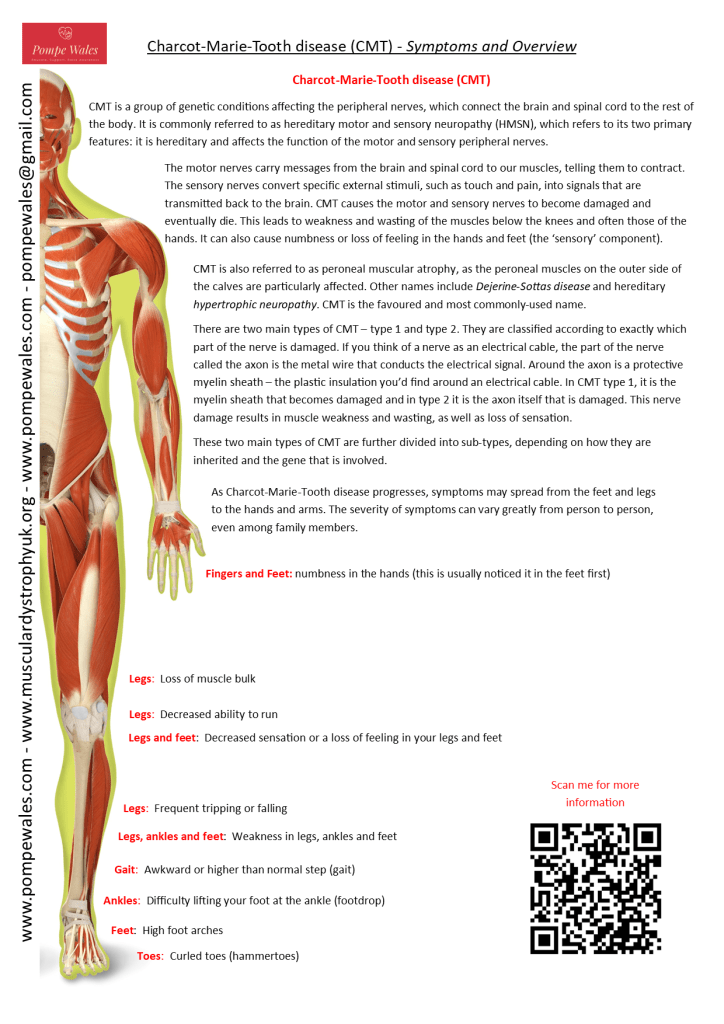
To download the infographic, click on the download button below.
Symptoms
In the more common types of CMT, the first signs usually appear in the first 10 years of life. In other types, it may not be until very much later, even into middle age. Parents may well notice the first symptom, which is often a slight difficulty in walking because of problems with picking up the feet.
Many people with CMT, particularly CMT type 1, have high arched feet (known as pescavus). This may be obvious from a very early age and tends to become particularly noticeable at the time of the growth spurt associated with puberty. Some people have weakness in their hands, but this does not usually cause symptoms until after the age of 20.
People can have numbness in their feet and hands (they usually notice it in the feet first), which is not often troublesome. Having cold feet is quite common too. Very rarely, people can experience severe numbness, which means you can easily injure or hurt yourself without knowing it. For example, you may develop ulcers on your feet if your shoes don’t fit well, or burn your hands on hot cups, and so on.
Although pain is a common experience for people with CMT, neuropathic pain (nerve pain which has specific characteristics) is less common. What can be more common is pain from secondary effects on the joints or from foot deformities, or muscle cramps. People may lose the reflexes (such as the knee jerk), which doesn’t cause any trouble, but doctors will often notice this early on. A few people with CMT 1 have shakiness of the hands (tremor). The combination of tremor and CMT is sometimes referred to as the RoussyLevy syndrome.
The types of CMT which run through the generations in families are not usually severely disabling and are very slowly progressive. It is unusual for people with CMT to lose the ability to walk, although some people – especially when they are older – need to use a stick or other walking aids. It is important to stress that the condition often varies enormously in severity, even among members of the same family. Ten to 20 percent of people with the condition have no symptoms at all, however examination or electrical testing may show that they do have the condition.
Diagnosis
It is important to determine exactly what type of CMT someone has, so that they can receive the correct care and understand the inheritance pattern too.
This can be achieved through careful examination, taking a family history, electrical tests and genetic studies on blood samples. This sort of assessment can also distinguish CMT from other non-genetic causes of neuropathy. The initial and most important tools in diagnosing CMT are electrical tests (called nerve conduction studies), which measure the patterns of electrical activity present in the nerves and record how quickly and how well electrical impulses travel along them. Children with CMT 1A will show the typical electrical abnormality from about the age of five.
Genetic tests are usually performed on a blood sample. The tests aim to identify which faulty gene is causing a condition and the precise nature of the genetic fault, in other words, the mutation. There are several different types of mutation, which are named for their effect on the DNA. For instance, a ‘deletion mutation’ is caused when some of the DNA is deleted and ‘duplications’ occur when part of the DNA is repeated. Testing for the chromosome 17 duplication, which causes most cases of CMT 1A, is widely available in most regional genetic laboratories. Some genetic laboratories or researchers have recently begun to use new sophisticated techniques to identify mutations in genes. To find out more about testing for a specific sub-type of CMT, contact your local genetic counselling centre. They may need to do a detailed assessment, including blood and electrical tests, of your close relatives.
If you have any questions, please contact us on 020 7803 4800 or info@musculardystrophyuk.org. Occasionally, members of a family with CMT, who don’t have signs of the condition or electrical abnormalities, may request a genetic test to see if they are likely to develop the condition in the future (predictive testing). In unaffected children, it is advised to wait until they are adults and can make their own decisions about testing.
 Pompe Disease